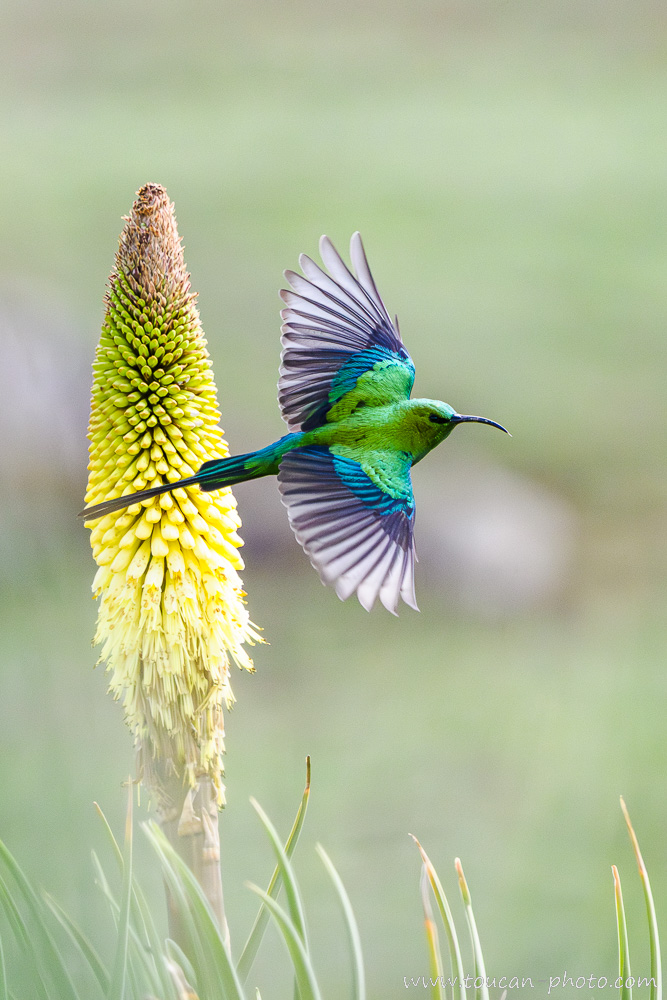
Malachite Sunbird (Nectarinia famosa) taking off from a Kniphofia foliosa, photographed in the highlands of Ethiopia
After sipping nectar from the long blossoms of an Kniphofia foliosa, the Malachite Sunbird (Nectarinia famosa) takes flight once more. A nearly silent departure, suspended between two wingbeats, where everything seems completely still despite the speed.
This scene was captured in the highlands of Ethiopia, where the striking flower spikes of the Kniphofia foliosa dot the high-altitude landscapes. Rich in nectar, they represent a precious resource for the Malachite Sunbird (Nectarinia famosa), a tiny passerine whose long, curved bill is perfectly adapted for exploring these flowers.
Photographing these birds requires as much patience as it does luck. Their takeoff is entirely unpredictable and lasts only a fraction of a second. When finally captured, this fleeting instant reveals all the grace and precision in the flight of these true winged jewels.
Yet, behind this incredible agility lies an equally fascinating adaptation. During the day, the Malachite Sunbird’s heart can beat between 500 and 1,000 times per minute to power its rapid metabolism and swift flight, sometimes hovering right before the flowers. However, as night falls over the Ethiopian mountains and temperatures plummet, it adopts a radically different strategy: it enters torpor, a state of deep rest during which its heart rate can drop to around 50 beats per minute. Its body temperature also decreases significantly, allowing it to conserve vital energy until the return of the first sunbeams.
This alternation between some of the most intense activity in the avian world and extreme energy conservation perfectly illustrates the Malachite Sunbird’s extraordinary capacity to adapt to its mountain environment.