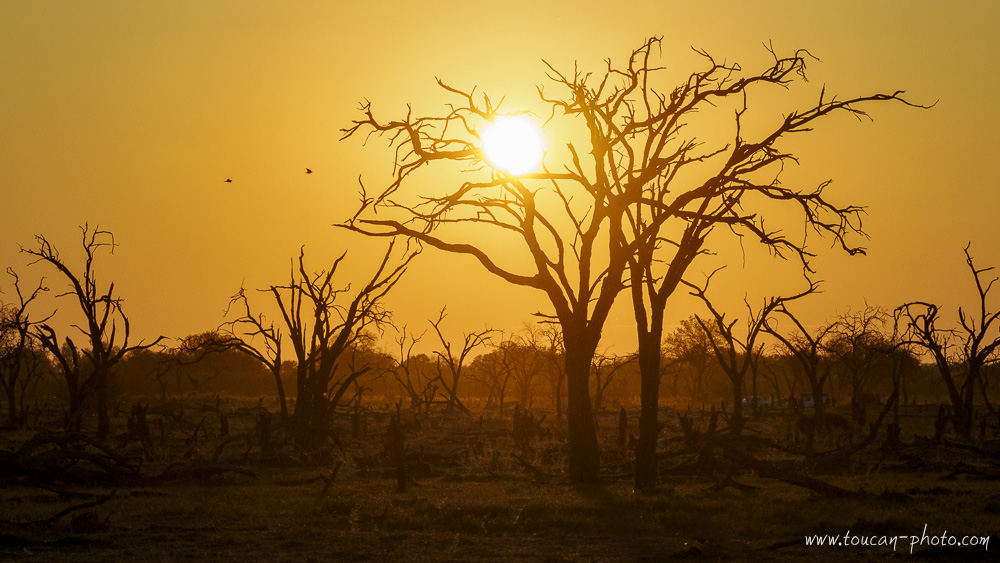
At sunset, the dead trees of Khwai stand silhouetted against the golden sky, bearing witness to a past flood.
In Khwai, Botswana, these dead trees stand as bare silhouettes in the golden light of the setting sun. Their demise followed a period of flooding, when the waters of the Okavango River spread across this part of the floodplain. Although the area has since dried out, the trees did not survive the prolonged inundation. The landscape thus retains the memory of an episode during which water profoundly altered the environment.
In this region of northern Botswana, the landscape is closely linked to the seasonal fluctuations of the Okavango’s waters. Floods can submerge extensive areas, temporarily transform grasslands into wetlands and alter the conditions in which vegetation grows. When the water recedes, some areas return to their dry appearance, but the effects of flooding can persist long after the waters have withdrawn.
Prolonged inundation can deprive tree roots of oxygen and ultimately cause their death, particularly when soils remain saturated for extended periods. Even after drier conditions return, damaged trees may die and remain standing for years, becoming visible reminders of the landscape’s changing hydrology.
As the sun sinks beyond the floodplain, these bare silhouettes create an almost otherworldly scene. Beyond their striking graphic beauty, they remind us that in landscapes shaped by seasonal floods, water is both a source of life and a powerful force capable of transforming ecosystems over time.
