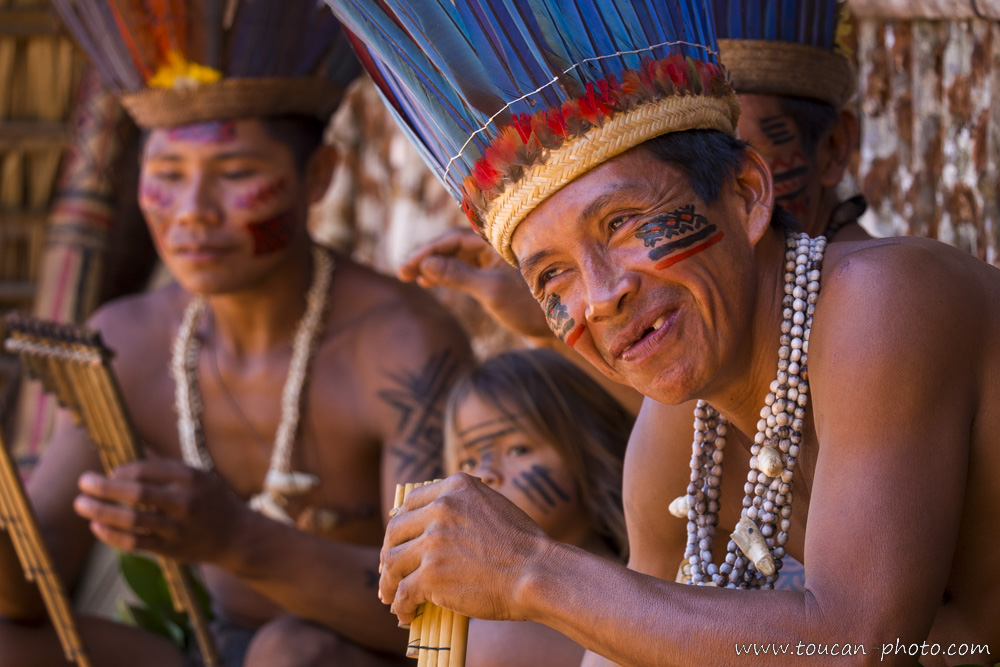
Tupes, Amazonia, Brasil
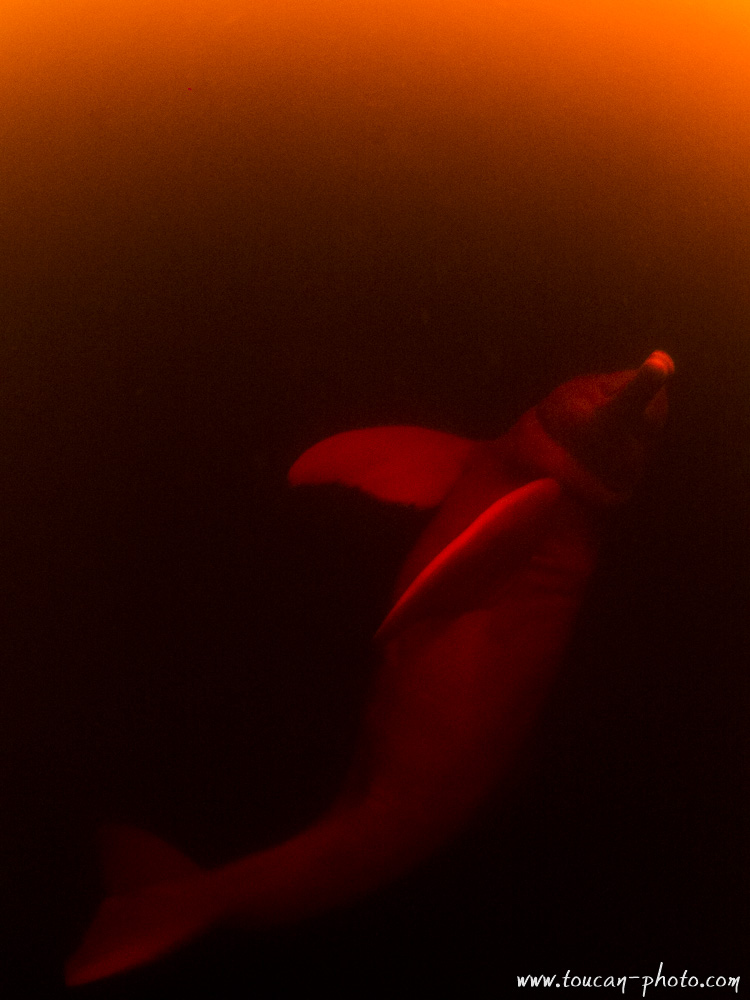
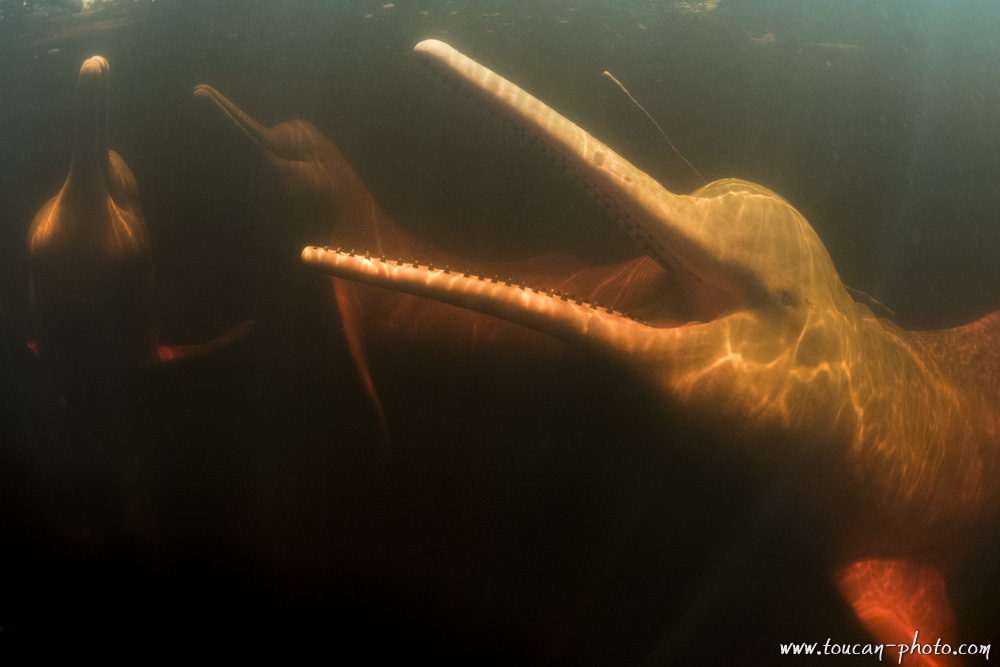
A Boto (Inia g. geoffrensis), a south american species of fresh water dolphin appears from the dark waters of the Rio Negro river
Read the paper about the Boto to learn more from this dolphin
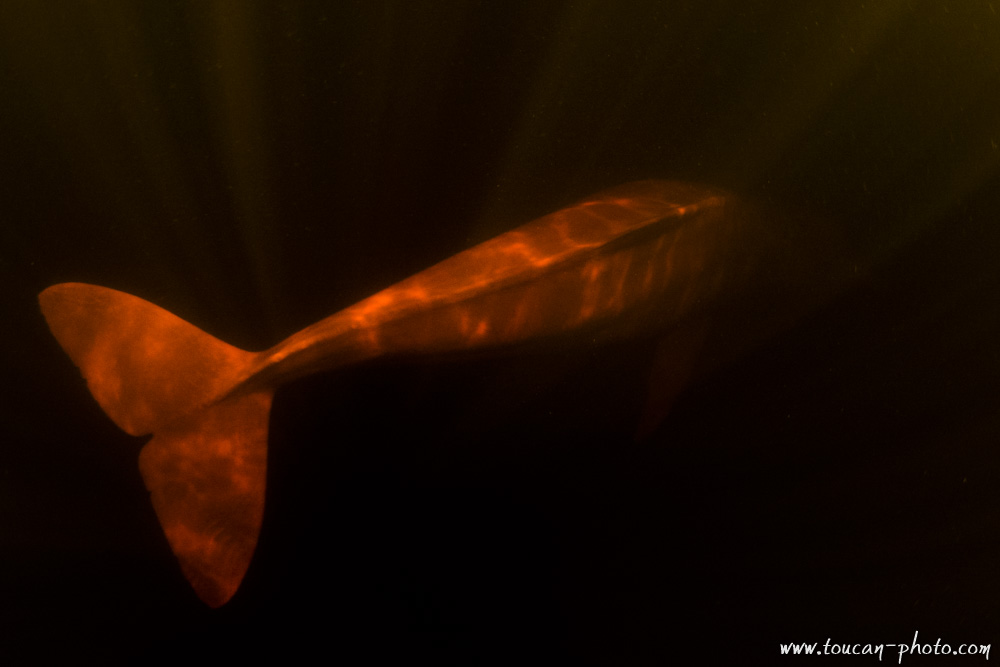
A Boto (Inia g. geoffrensis), a south american species of fresh water dolphin disappears into the dark waters of the Rio Negro river
Read the paper about the Boto to learn more from this dolphin
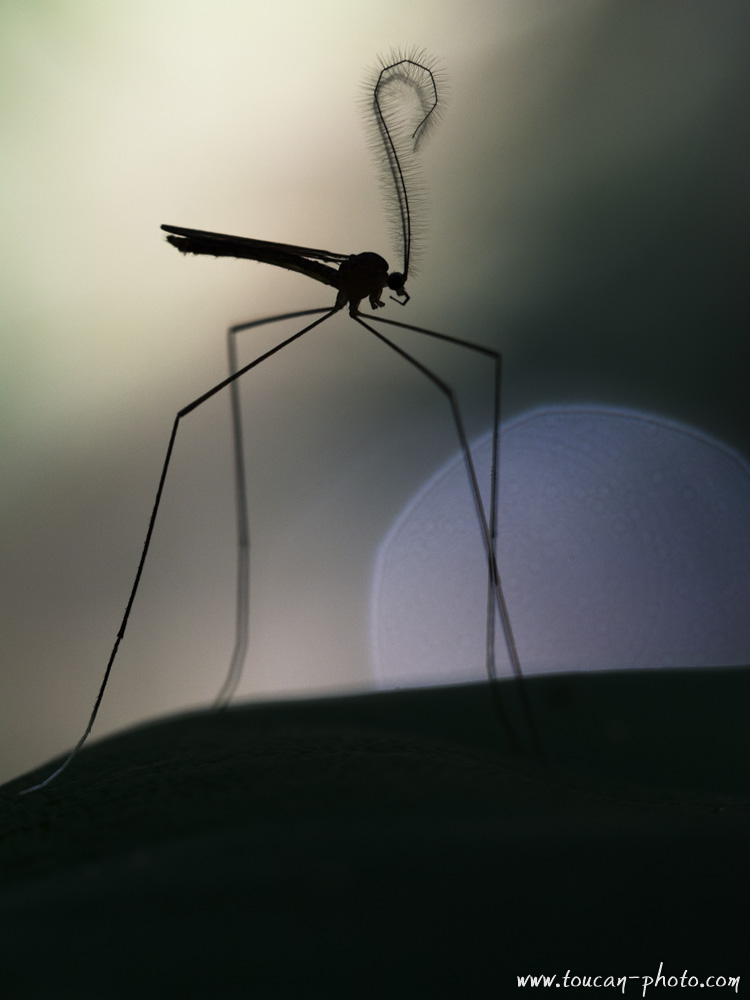
Mosquito, Amazonia, Brazil
Is the Mosquito the most dangerous animal living on earth?
Many diseases are transmitted by this insect, such as malaria (with 250 million cases annually, the disease kills more than 900,000 people per year), the yellow fever (affects 200,000 people per year and is fatal to 30 000 people), dengue (the most serious variation strikes 500 000 people per year) …
23 to 7 million years ago, during the Miocene era, Amazonia was partially covered by seawater. Cetaceans were living in this area. When seawater has been definitely out of Amazonia ground, a species would have adapted to continue living in rivers, drawing the Amazonian landscape. This species became the Boto, known also as the biggest pink dolphin of Amazonia.
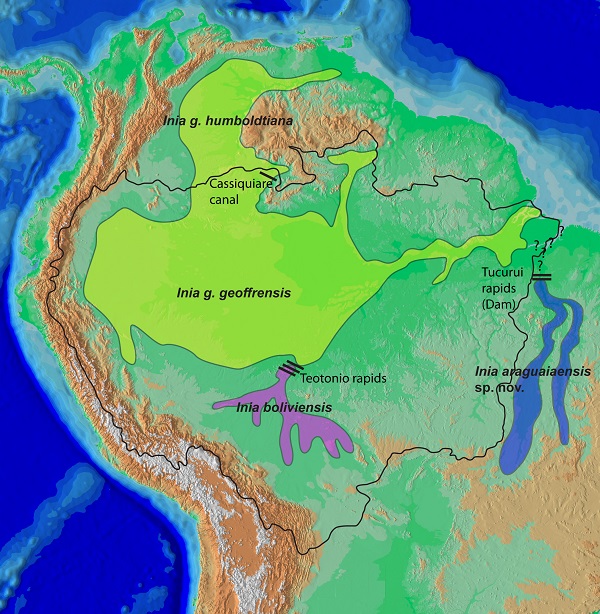
Genus Inia range of distribution. Represented in green, the distribution of Inia g. geoffrensis, also known as the « Boto ».
In the Amazonian pond, the water of rivers can have different colors. Some rivers appear to be ochre (sometimes whitish) and derive their color from the big quantity of clay. This is the case, for example, of the Amazon river. We can barely see under the water in this kind of river. Others, called ‘black water’ derive their color from the huge concentration of iron and decomposing organic materials. These rivers are very acid, such as the Rio Negro. Despite this ‘tea’ color, the water is not unclear and even when it is dark we can see up to 2 meters deep. The photographs presented in this article have been made in the dark waters of Rio Negro.
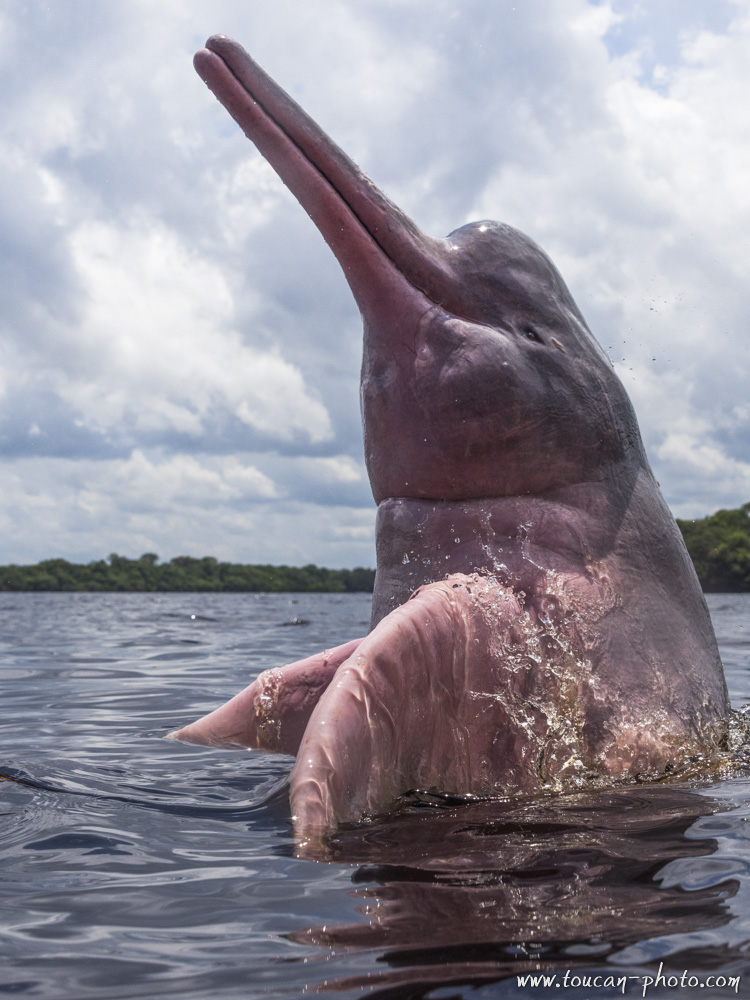
At the surface, we see the pink color which is a characteristic of the Boto.
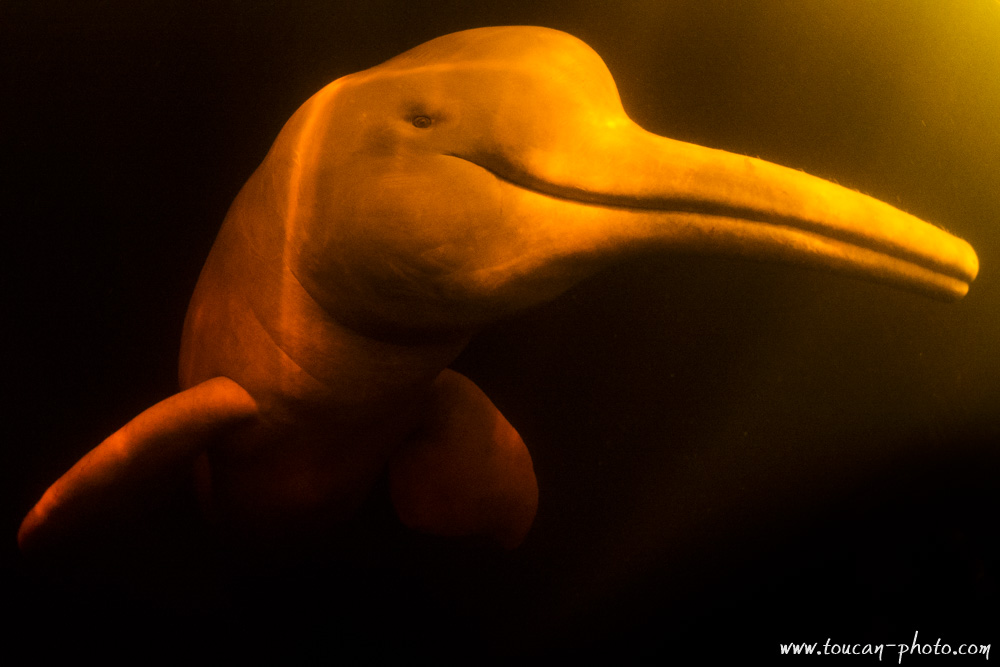
In the « tea » color waters of Rio Negro, the dolphin seems to have an orange color.
The Boto, at adult age, measures around 2.80 meters long and weights up to 150kg for the male. The female are generally smaller, measure about 2 meters and weight around a hundred kilos. This dolphin lives exclusively in fresh waters of the Amazon pond. We can see them in Peru, in Ecuador and Bolivia but more specifically in Brazil. These pink dolphins are part of the 5 smartest cetacean species in the world. They are very sociable and can be approached from a boat or even under water. The Boto will have an aggressive behavior only if he feels threatened.
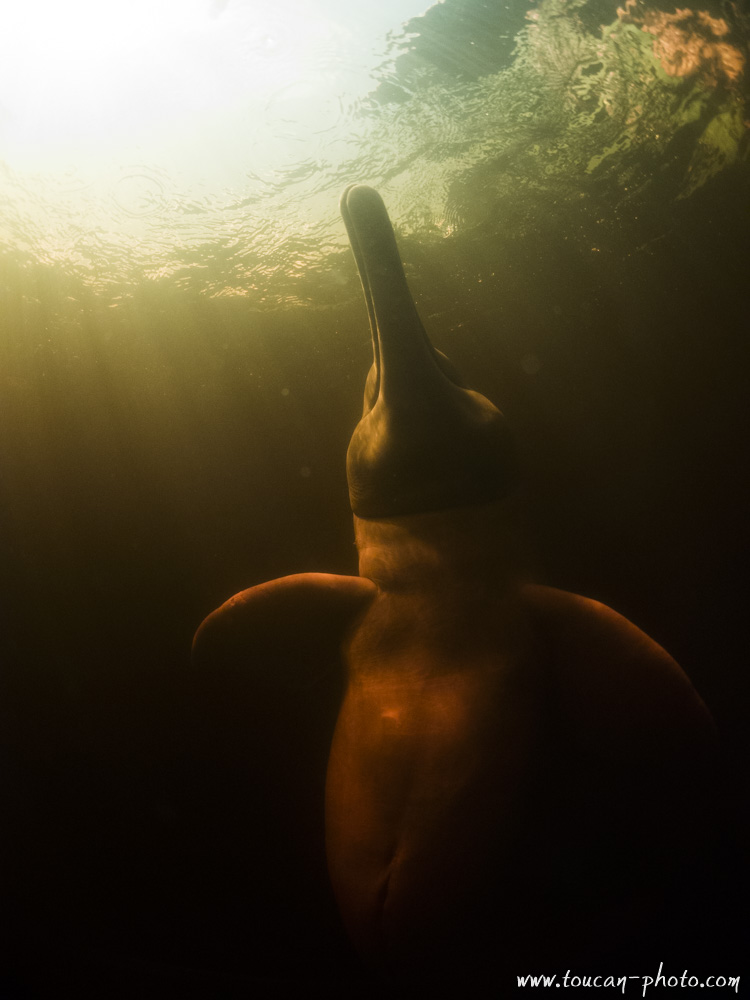
The darkness occurs as depth increases. After few meters deep, it is really dark.
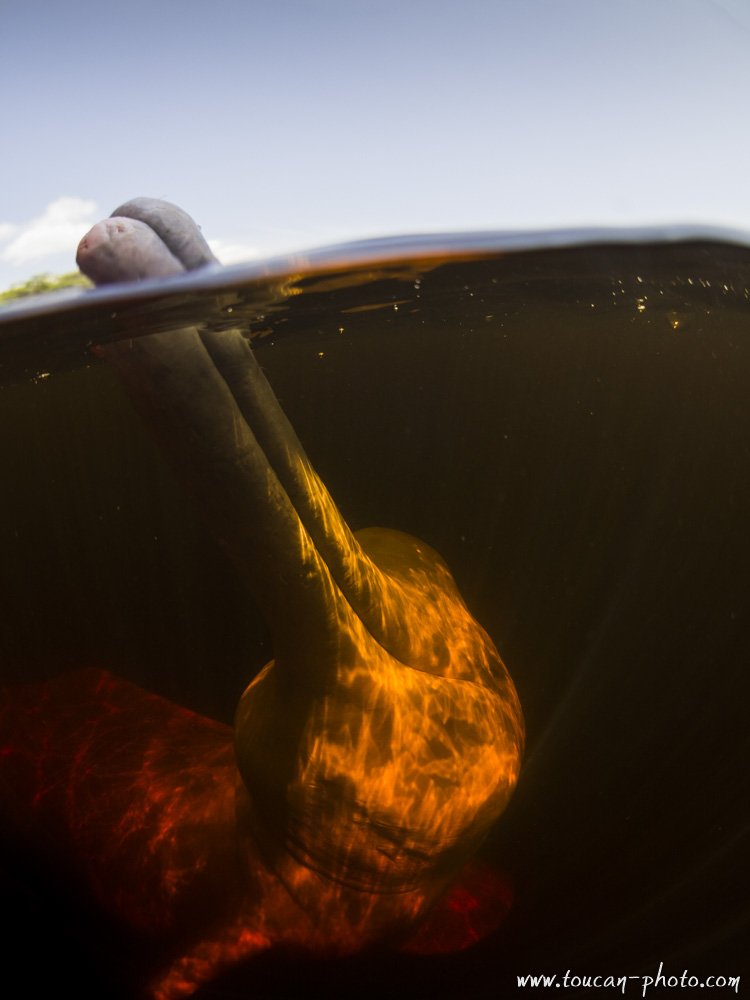
Dolphin sharping the surface with its muzzle.
Anatomical Flexibility: Unlike other dolphins, the Boto has a very short dorsal fin in order not to be shackled when it moves under the immersed roots. Moreover, its cerebral vertebrae are not brought together, giving it incredible flexibility. Thus, the Boto is capable of spinning the head at 90° (an incredible feat for a cetacean), facilitating its movements between trees in flooded area.
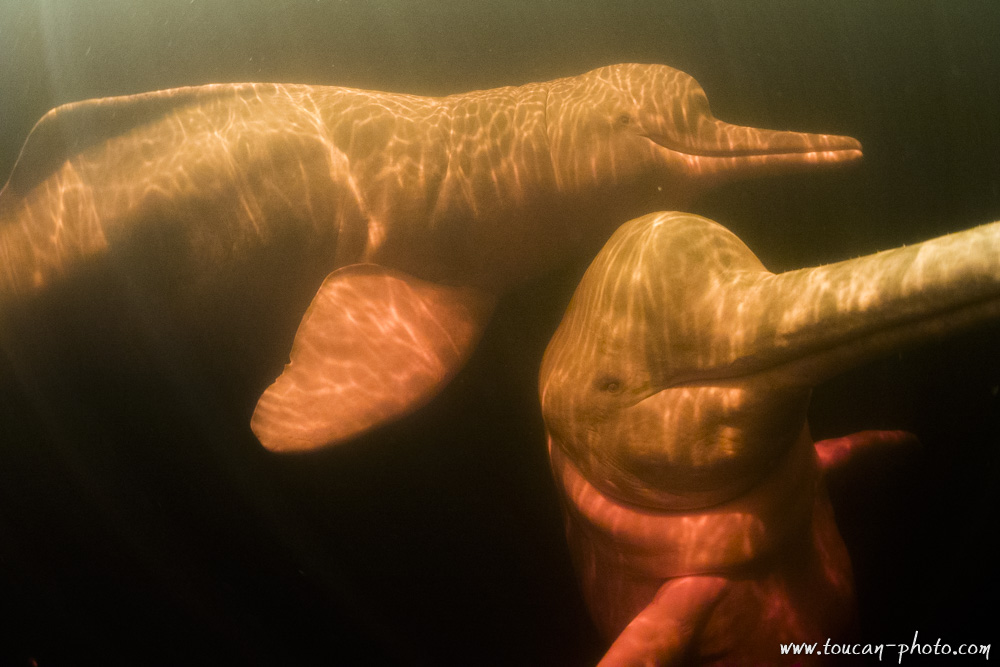
The Boto uses echolocation (sophisticated sonar on the forehead) and has whiskers on the muzzle capable of transmitting surrounding vibrations (similar to a cat’s whiskers). These advantages enable the Boto to detect and hunt fishes with accuracy even though the visibility is often weak.
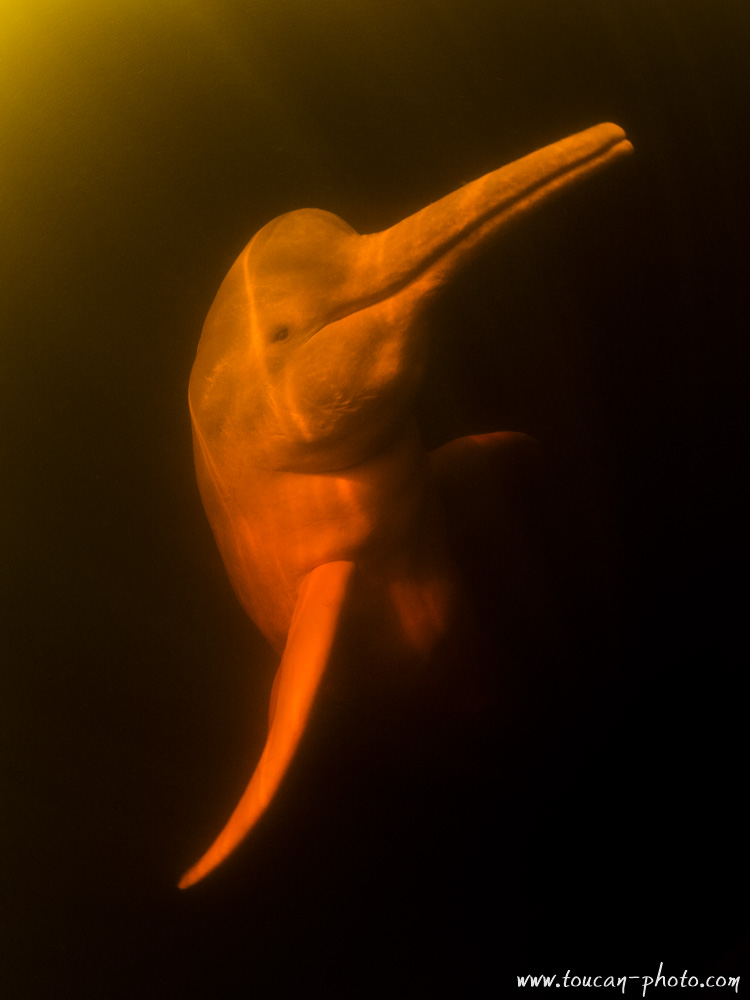
The Origin of the Color: Young Botos are grey and male adults are much more pink than females. One theory suggests the color comes from their playful and warrior character. Botos love arguing and nipping each other; the resulting scar tissue is pink, giving them their characteristic color over the years.
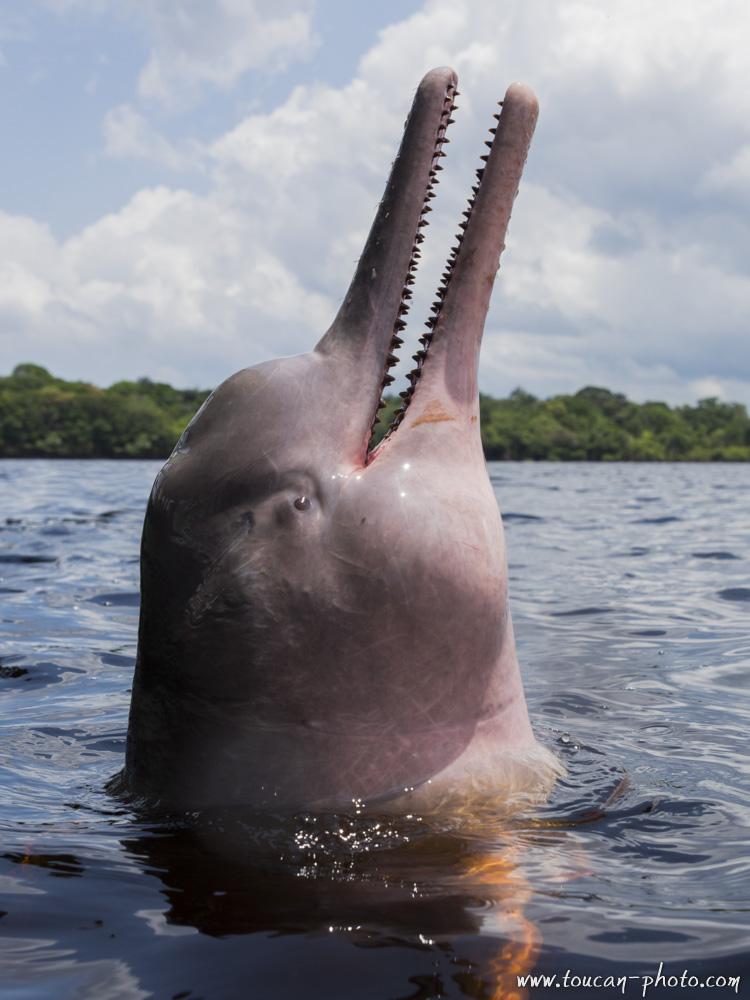
A Boto and its healed skin.

Reproduction occurs between September and December at the lowest water level. After 10 to 11 months of gestation, the female gives birth to one baby (when water is highest). The calf is 80 cm long and grey. The mother suckles the baby for about a year, and independence is reached after 2 to 3 years. Sexual maturity is between 6 and 10 years old.
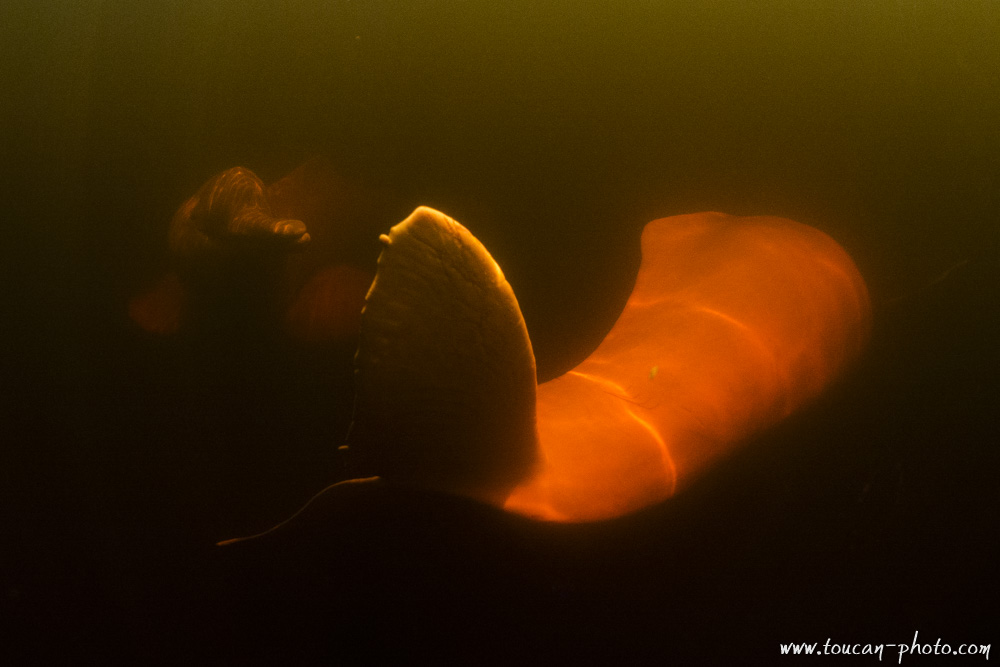
The Boto eats essentially fishes (more than 50 species). With a solid jawbone, it can also break the shells of crabs and river turtles. An adult Boto eats around 2.5% of its body mass every day (averaging 3kg of fish).
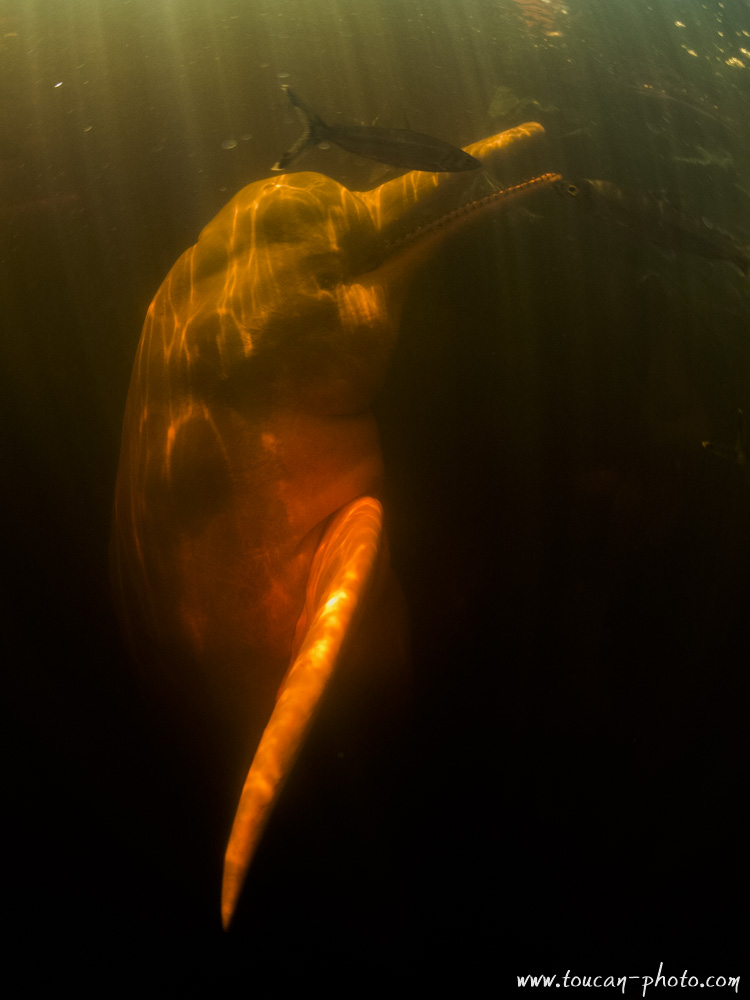
Legends and Folklore: Native legends say the Boto can take human form to infiltrate villages. He wears a hat to hide his respiratory vent and seduces young girls. This led to the expression « It is again the Boto » to explain unplanned pregnancies. Other stories mention fishermen fixing garlic to their boats for protection, or a mermaid queen dragging men to the bottom.
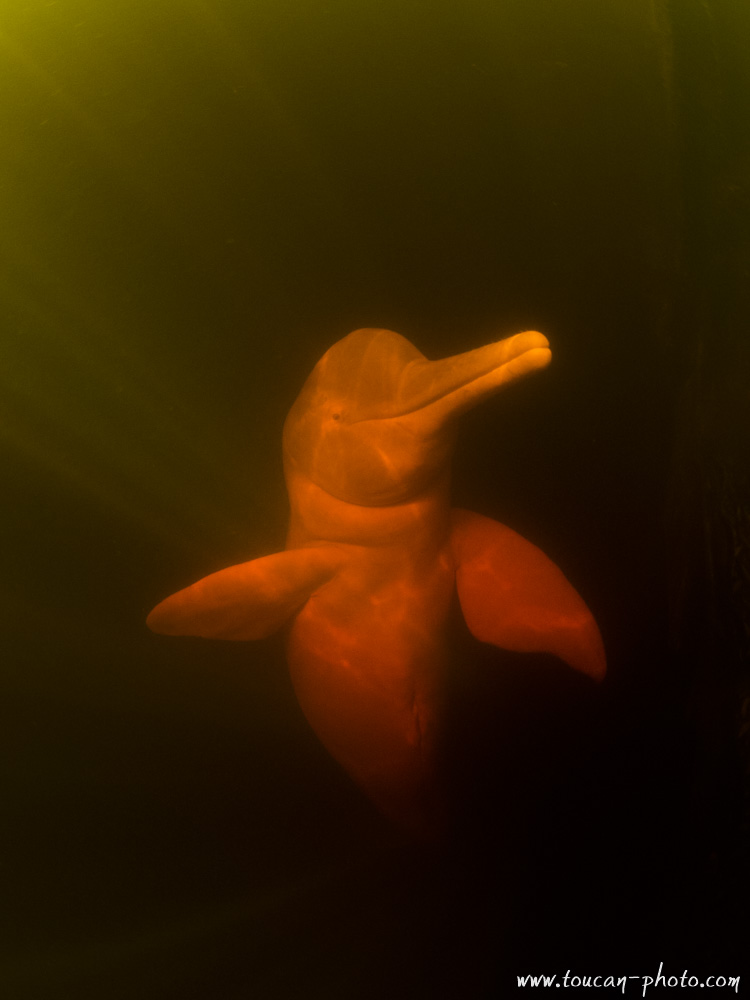
The Rio Negro mermaid, sometimes considered as the Botos’ queen.
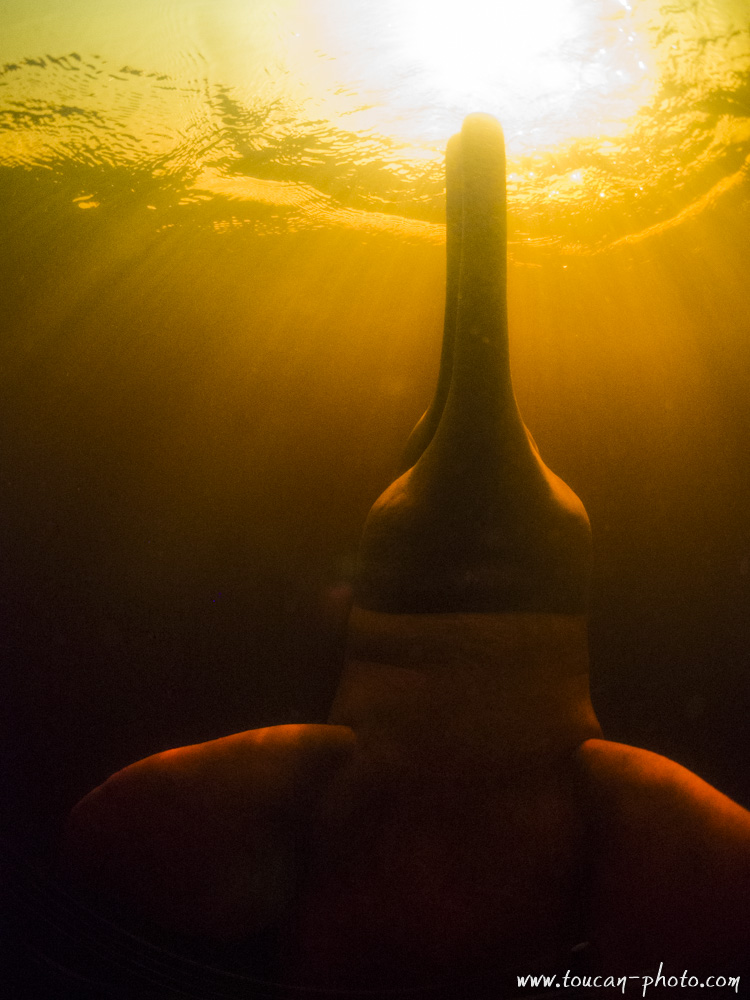
Mystical Boto.
The Boto population is estimated at 100,000, but survival is compromised by poaching (used as bait for Piracatinga), mining pollution, and dams. About 7,000 Botos are killed each year. We hope it will not disappear like its Chinese cousin the Baiji, not seen since 2007.
— Continue the journey —
— Complementary Resources —


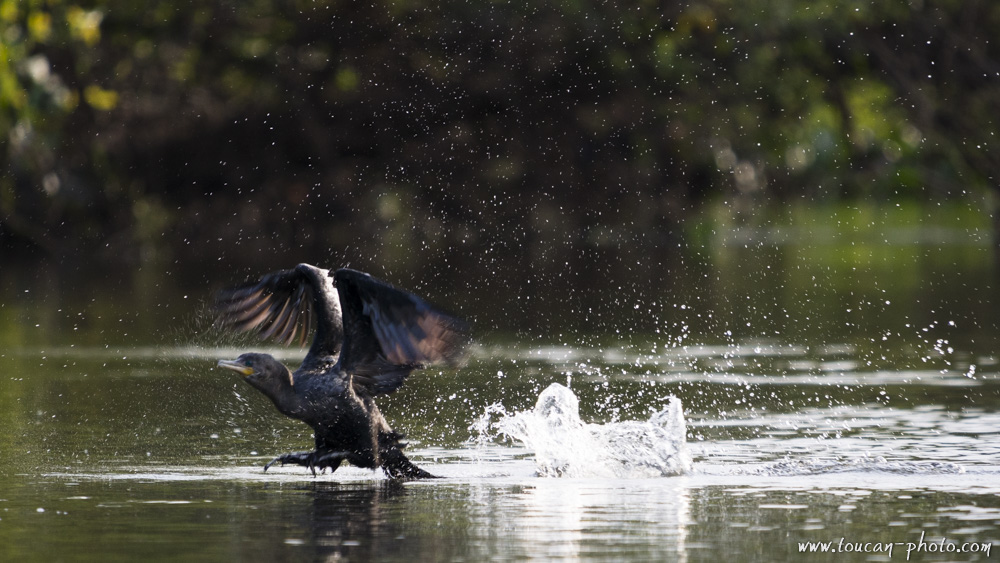 Neotropic cormorant, “O biguá” (Phalacrocorax brasilianus), Brazil
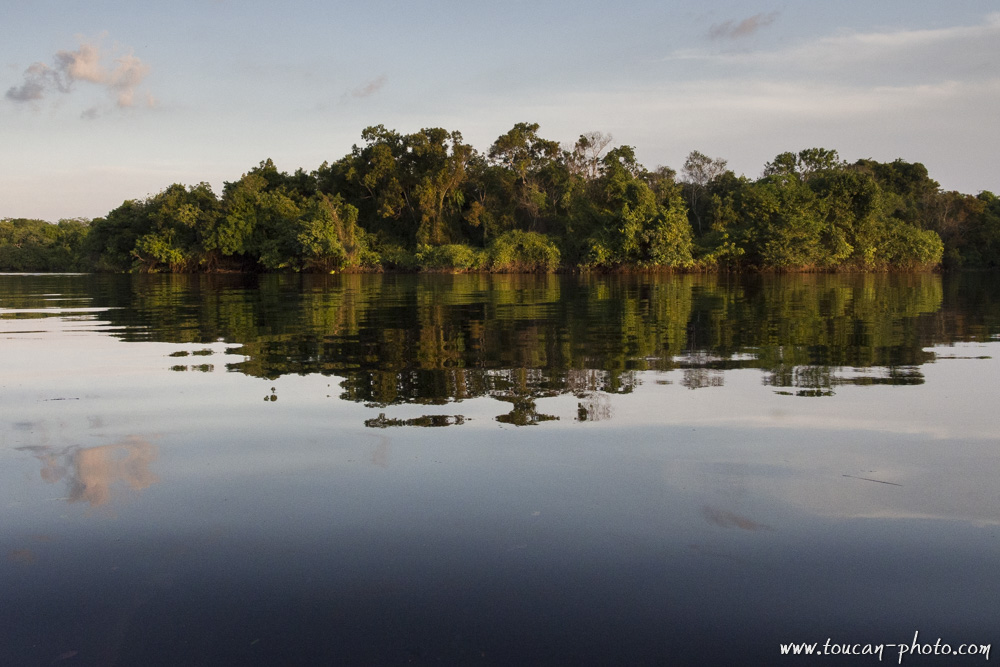 Rio Negro bank, Amazonia, Brazil
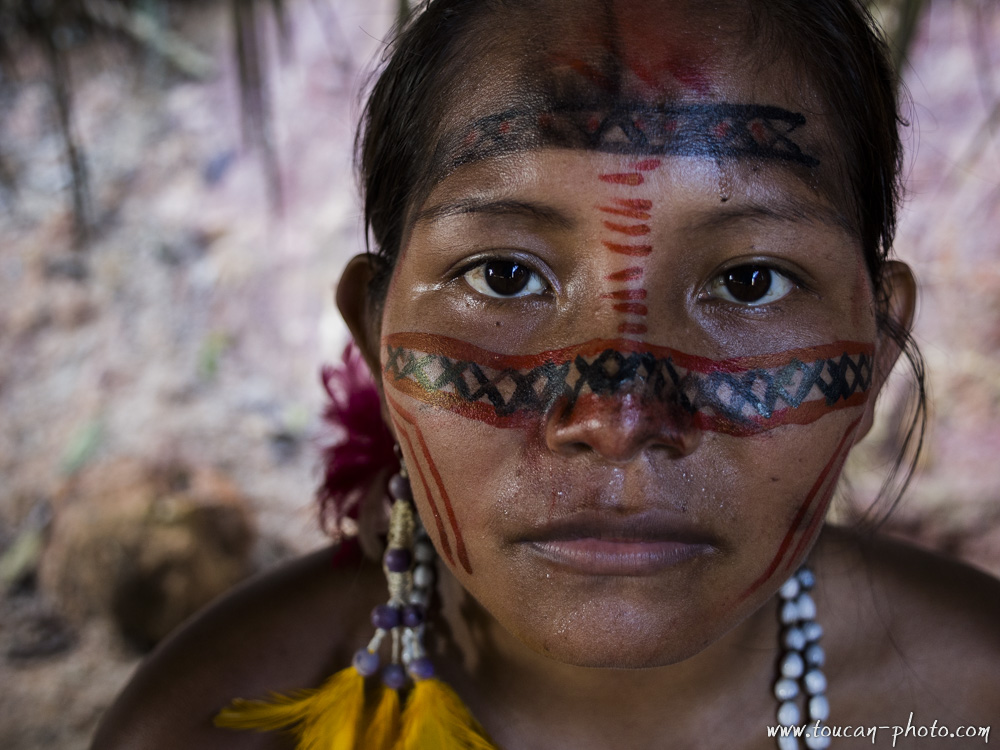 Young Tupé women, Amazonia, Brazil
 Brazil, Amazonian location. Young woman of the Dessana tribe watching a boat cruising the Rio Negro
 Sunrise over the Rio Negro, Amazonia, Brazil
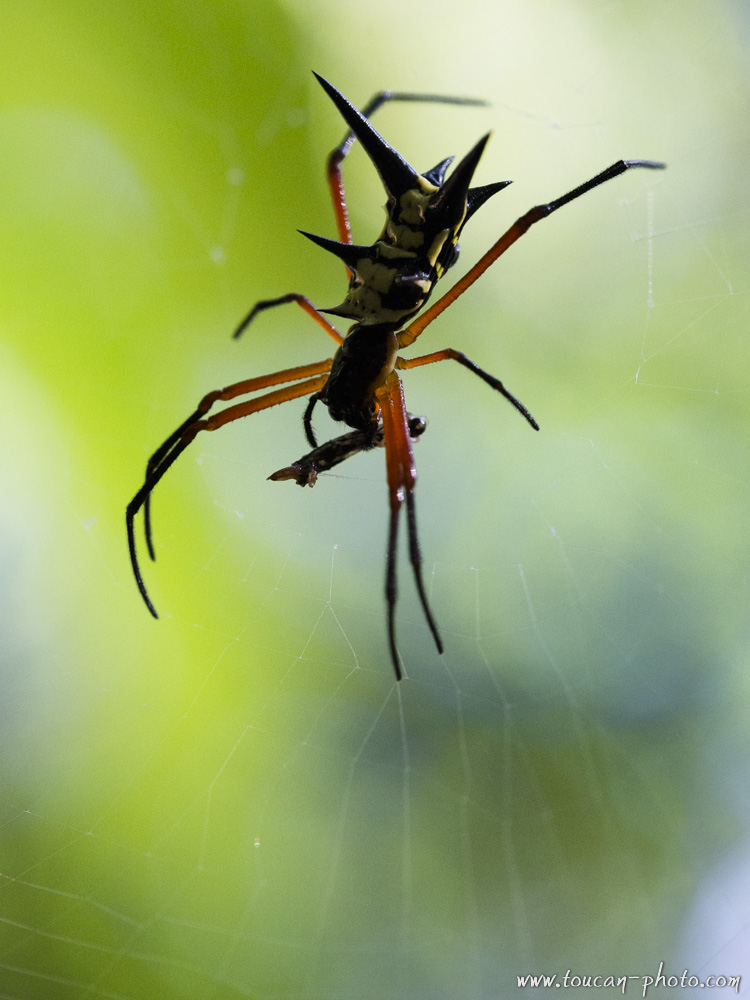 Spider (Micrathena kirbyi), Amazonia, Brazil