Lightning over the Puy de Dôme, Auvergne, France
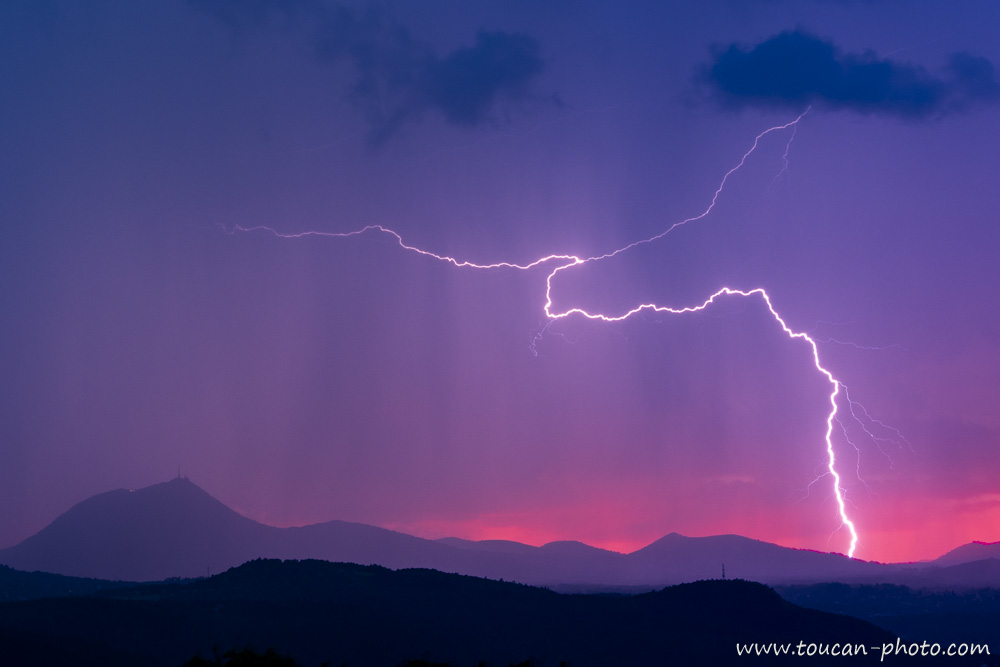
A powerful lightning strike illuminates the sky near the Puy de Dôme at dusk.
Few natural phenomena capture both awe and unease quite like lightning. In this photograph, a bolt tears across the sky, striking the landscape near the iconic volcanic summit of the Puy de Dôme. The intense contrast between the electric discharge and the fading light of sunset highlights the raw power of the atmosphere.
Beyond its visual impact, this location carries deep historical significance. During the Gallo-Roman period, the summit of the Puy de Dôme was home to a major temple dedicated to Mercury, one of the most important deities in Roman religion. Elevated sites such as this were often chosen for worship, bringing humans closer to the heavens and, symbolically, to the gods themselves.
Lightning, in ancient belief systems, was frequently interpreted as a manifestation of divine will. While in Roman tradition thunder was more commonly associated with Jupiter, king of the gods, the presence of a sanctuary to Mercury atop this mountain reinforces the idea of a sacred landscape where sky and earth converge. Witnessing lightning in such a place today inevitably echoes those ancient interpretations, reminding us of a time when natural forces were seen as direct expressions of divine power.
Today, science explains lightning as a massive electrostatic discharge between cloud and ground. Yet, standing before such a spectacle near a site once devoted to the gods, it is easy to understand why our ancestors perceived something far greater at work.