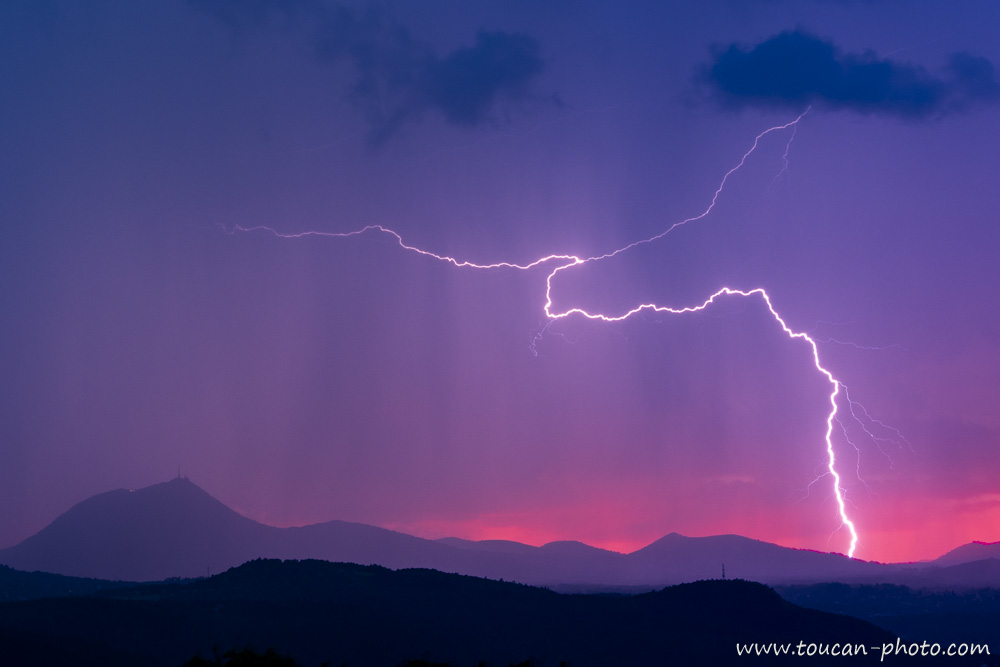
Lightning over the Puy de Dôme, Auvergne, France

Lightning striking near the Puy de Dôme at sunset, with dramatic purple and red sky over mountainous landscape in France

Lightning over the Puy de Dôme, Auvergne, France

A powerful lightning strike illuminates the sky near the Puy de Dôme at dusk.

Few natural phenomena capture both awe and unease quite like lightning. In this photograph, a bolt tears across the sky, striking the landscape near the iconic volcanic summit of the Puy de Dôme. The intense contrast between the electric discharge and the fading light of sunset highlights the raw power of the atmosphere.

Beyond its visual impact, this location carries deep historical significance. During the Gallo-Roman period, the summit of the Puy de Dôme was home to a major temple dedicated to Mercury, one of the most important deities in Roman religion. Elevated sites such as this were often chosen for worship, bringing humans closer to the heavens and, symbolically, to the gods themselves.

Lightning, in ancient belief systems, was frequently interpreted as a manifestation of divine will. While in Roman tradition thunder was more commonly associated with Jupiter, king of the gods, the presence of a sanctuary to Mercury atop this mountain reinforces the idea of a sacred landscape where sky and earth converge. Witnessing lightning in such a place today inevitably echoes those ancient interpretations, reminding us of a time when natural forces were seen as direct expressions of divine power.

Today, science explains lightning as a massive electrostatic discharge between cloud and ground. Yet, standing before such a spectacle near a site once devoted to the gods, it is easy to understand why our ancestors perceived something far greater at work.
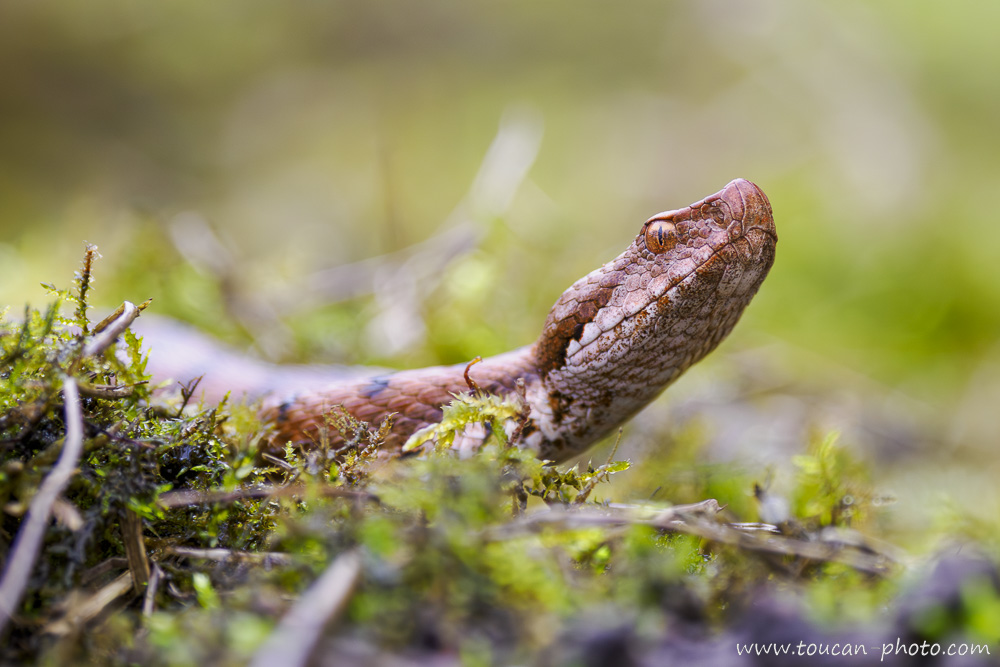
Asp viper in the heart of the moss

Close-up of an asp viper (Vipera aspis) in woodland, head raised, showing its scales and vertical pupil

Asp viper in the heart of the moss

An asp viper (Vipera aspis) moves discreetly between moss and twigs.

Discreet and often feared, the asp viper is nevertheless a fascinating animal that plays an essential role in ecosystem balance. Found across many regions of Europe, it particularly favors dry, sunny habitats, as well as woodland areas where it can blend into its surroundings.

In this image, one can observe the fineness of its scales and the subtlety of its coloration. Nearly motionless, it carefully monitors its surroundings, ready to flee at the slightest disturbance rather than attack.

Contrary to common belief, the asp viper is not aggressive toward humans. Bites are rare and usually occur when the animal is surprised or handled. Observing it from a distance, as shown here, allows one to appreciate the full beauty of this often misunderstood reptile.

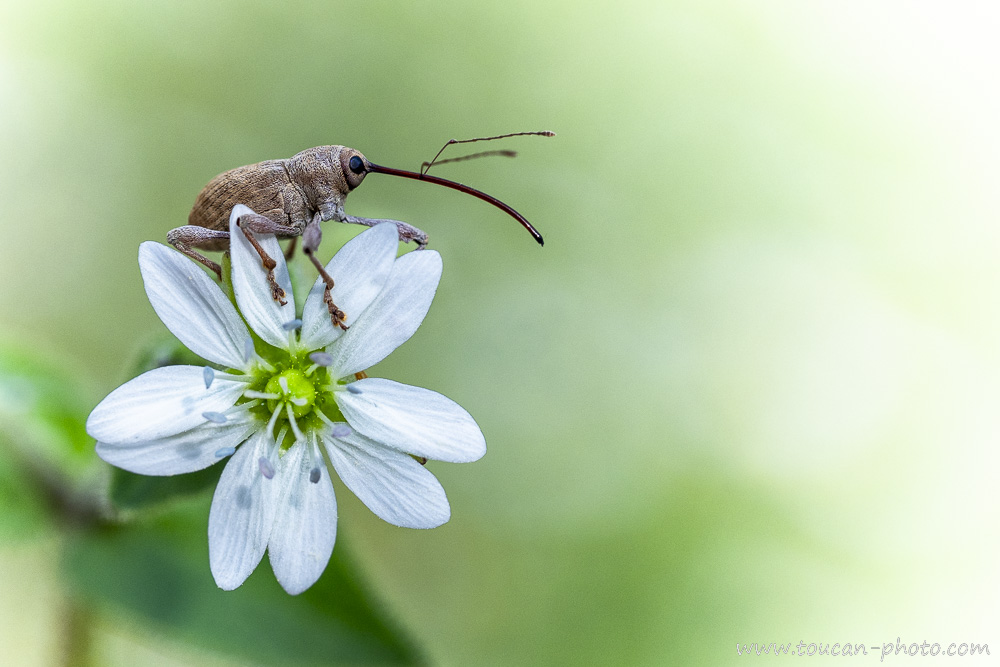
Chestnut weevil (Curculio elephas) on a flower – France

Chestnut weevil (Curculio elephas) on a flower - France

The Chestnut weevil, a garden astronaut.

Carefully perched on the pristine petals of a stitchwort, this Chestnut weevil (Curculio elephas) looks like a creature straight out of a science fiction story with its spectacular rostrum.

This small beetle, an icon of the French countryside, possesses a unique tool: a rigid, extremely thin snout that allows it to bore into plant tissues. In the female, this rostrum is a feat of natural engineering used to pierce the still-soft shells of chestnut to deposit an egg.

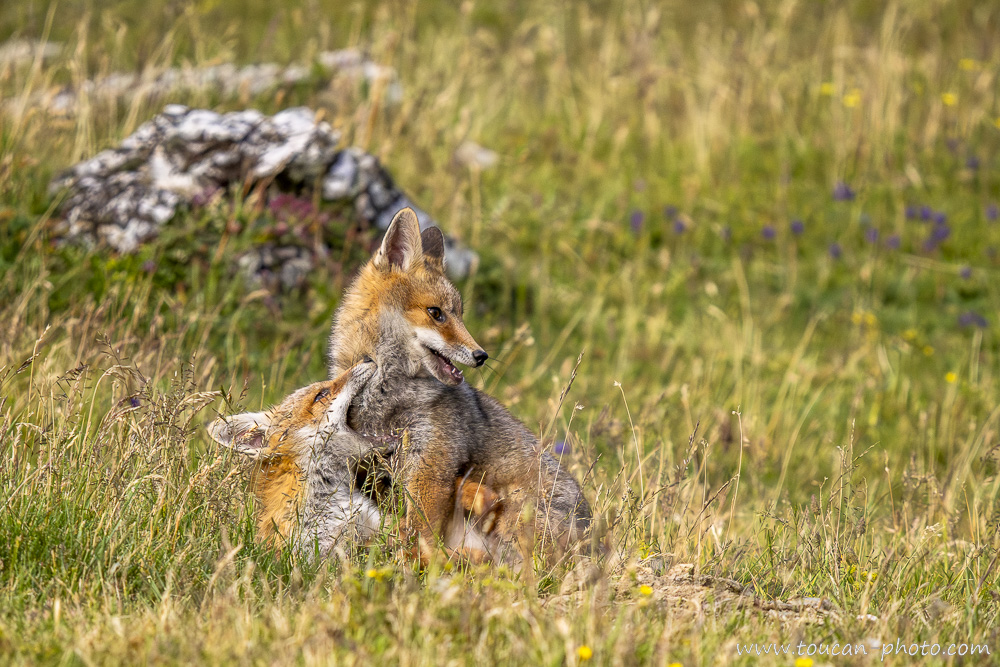
Young foxes playing in the tall grass – France

Young foxes playing in tall grass - Late summer

Young foxes, learning through play.

In the golden light of a late summer meadow, two young foxes engage in their favorite games, caught between tenderness and mock combat.

These moments of brotherhood are crucial in the development of fox cubs. Through play, they learn the social codes of their species and sharpen the reflexes that will later make them agile predators. Nestled against each other amidst the tall grasses and sun-scorched wildflowers, they remind us of the vulnerability and wild beauty of these first months of life in the heart of nature.

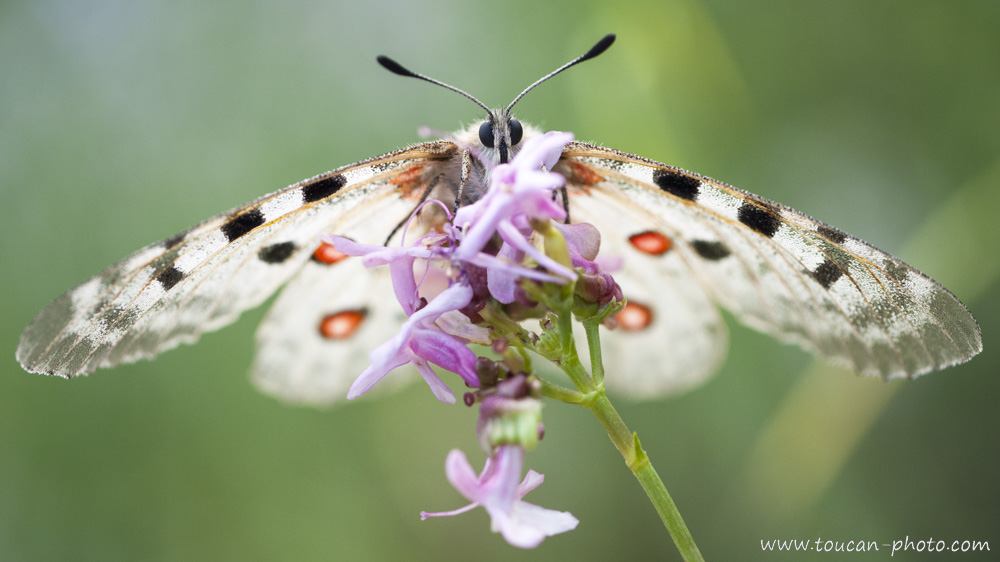
The Apollo: A Glacial Relic of the High Peaks

Apollo butterfly (Parnassius apollo rhodopensis) unfolding its wings in the mountains

A slow and powerful flight, carried by the thermal currents of the summits.

A true survivor from the glacial eras, the Apollo is one of the few butterflies capable of thriving at altitudes exceeding 2,000 meters.

Its sturdy body is covered in fine black hairs that act as a thermal coat, allowing it to absorb every bit of solar heat from the earliest light. Unlike many other butterflies, its flight is heavy and somewhat bird-like, alternating between steady wingbeats and gliding. This energy conservation is vital in an environment dominated by wind and cold. Seeing this white silhouette against the deep blue of the alpine sky remains one of the most magical moments for a mountain photographer.

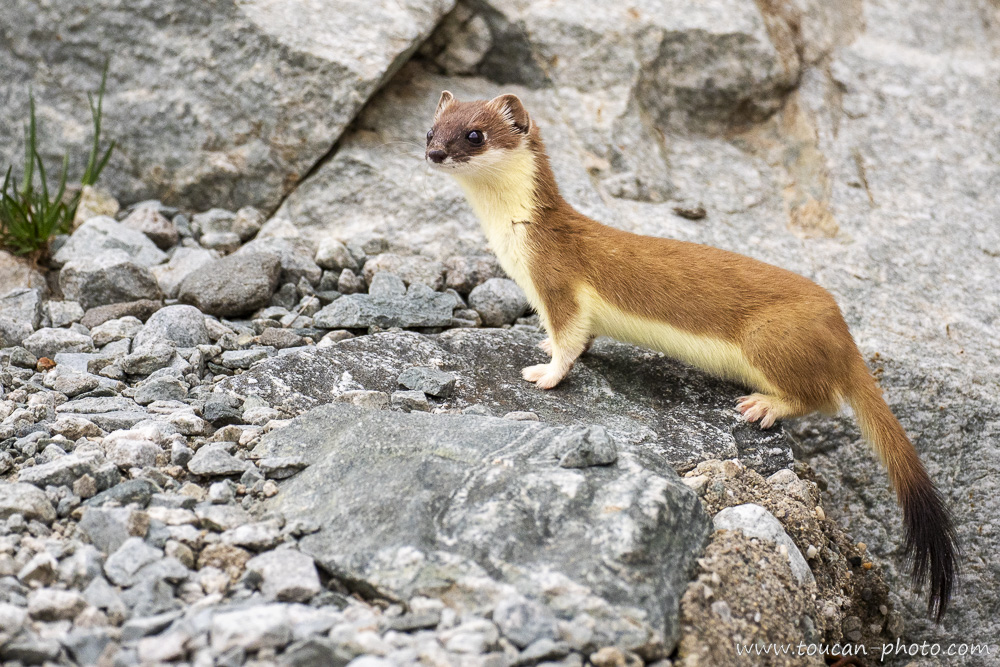
Eurasian ermine (Mustela erminea) – France

Stoat (Mustela erminea) in its natural habitat - France

The Stoat (Mustela erminea), an agile sentinel of the French mountains.

Lively and bold, this small carnivore is a master of camouflage and survival in rugged landscapes.

Famous for its coat that changes color with the seasons, the stoat trades its brown summer dress for immaculate white fur in winter, keeping only the deep black tip of its tail. This photograph captures the curious and alert expression of this mustelid, capable of slipping into the smallest crevices to track its prey. Despite its small size and elegant appearance, the stoat is a formidable and tireless predator, symbolizing the vital force that animates the mountainous and hedgerow environments of our regions.

?>
Next page