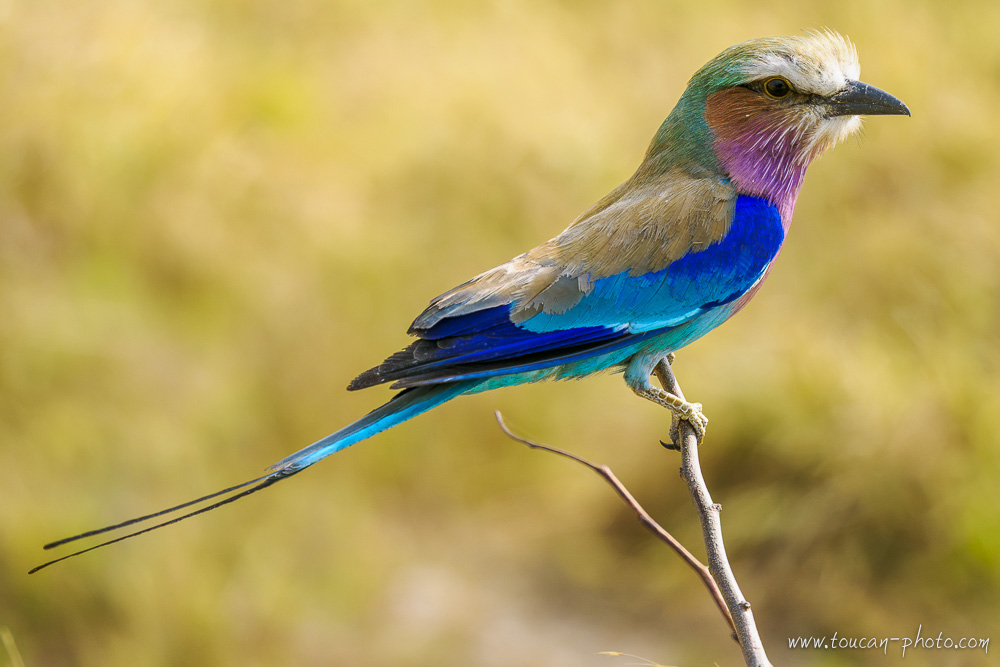
Lilac-breasted Roller, the Rainbow Bird – Botswana

A lilac-breasted roller (Coracias caudatus) perched on a branch in Botswana, displaying its turquoise, blue and violet plumage and long tail streamers.

The lilac-breasted roller, a true rainbow bird, perched in the Botswana savanna.

With its striking combination of turquoise, deep blue, lilac and violet, the lilac-breasted roller is one of the most colourful birds of the African savanna. Its two long tail streamers add elegance to its distinctive silhouette. Perched on a branch, it stands out against a bright, softly blurred background that brings out the full brilliance of its plumage.

Found across much of sub-Saharan Africa, this roller inhabits wooded savannas and open landscapes. It hunts from a perch, watching for insects and small vertebrates before swooping down on its prey. The species is also known for its spectacular aerial displays, featuring steep dives and acrobatic movements.

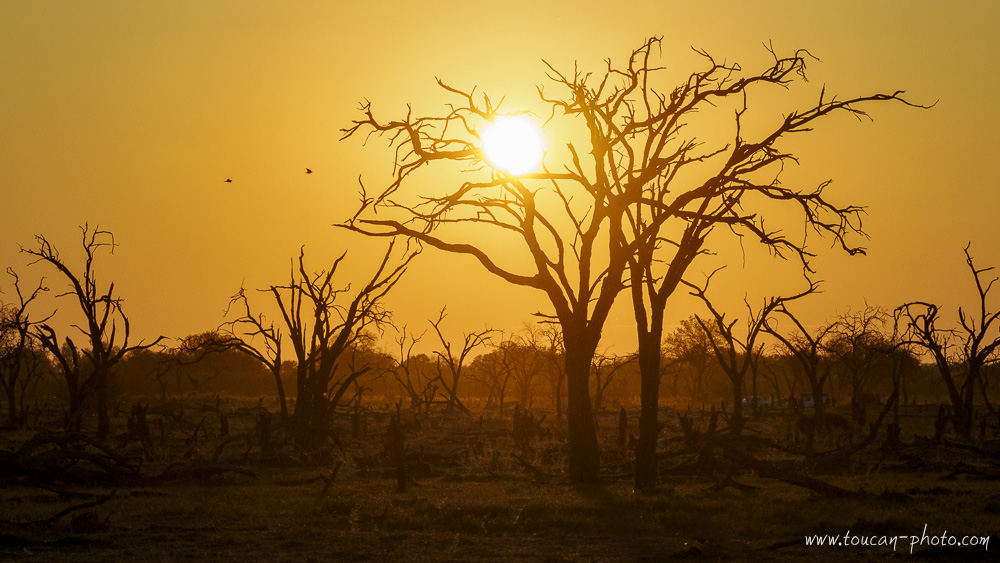
Khwai, trees bearing witness to a past flood – Botswana

Silhouettes of dead trees on the Khwai floodplains in Botswana at sunset, bearing witness to a past flood linked to the Okavango River.

At sunset, the dead trees of Khwai stand silhouetted against the golden sky, bearing witness to a past flood.

In Khwai, Botswana, these dead trees stand as bare silhouettes in the golden light of the setting sun. Their demise followed a period of flooding, when the waters of the Okavango River spread across this part of the floodplain. Although the area has since dried out, the trees did not survive the prolonged inundation. The landscape thus retains the memory of an episode during which water profoundly altered the environment.

In this region of northern Botswana, the landscape is closely linked to the seasonal fluctuations of the Okavango’s waters. Floods can submerge extensive areas, temporarily transform grasslands into wetlands and alter the conditions in which vegetation grows. When the water recedes, some areas return to their dry appearance, but the effects of flooding can persist long after the waters have withdrawn.

Prolonged inundation can deprive tree roots of oxygen and ultimately cause their death, particularly when soils remain saturated for extended periods. Even after drier conditions return, damaged trees may die and remain standing for years, becoming visible reminders of the landscape’s changing hydrology.

As the sun sinks beyond the floodplain, these bare silhouettes create an almost otherworldly scene. Beyond their striking graphic beauty, they remind us that in landscapes shaped by seasonal floods, water is both a source of life and a powerful force capable of transforming ecosystems over time.
Red-billed Oxpecker and Impala – Botswana

Red-billed oxpecker perched on the back of a female impala in Botswana

A red-billed oxpecker (Buphagus erythrorynchus) perched on the back of a female impala (Aepyceros melampus) in Botswana.

The red-billed oxpecker spends much of its time clinging to large African mammals. It feeds mainly on ticks and other parasites that it picks directly from their skin, gaining a source of food while removing some of these unwanted guests from its hosts. The bird pictured here is perched on the back of a female impala, who seems to be watching it closely.

This association is often described as an example of cooperation between species. However, the relationship is more complex than it first appears: while oxpeckers consume many parasites, they may also feed on blood and wounds, sometimes preventing them from healing. It is an interaction that can be both beneficial and troublesome, illustrating the subtle balances of life in the wild.

?>